Inside a Paper Trading App: How Virtual Trading Simulates the Real Stock Market
Curious how a stock trading simulator mirrors real markets before you pick the best trading app? Here's exactly how virtual trading engines work.
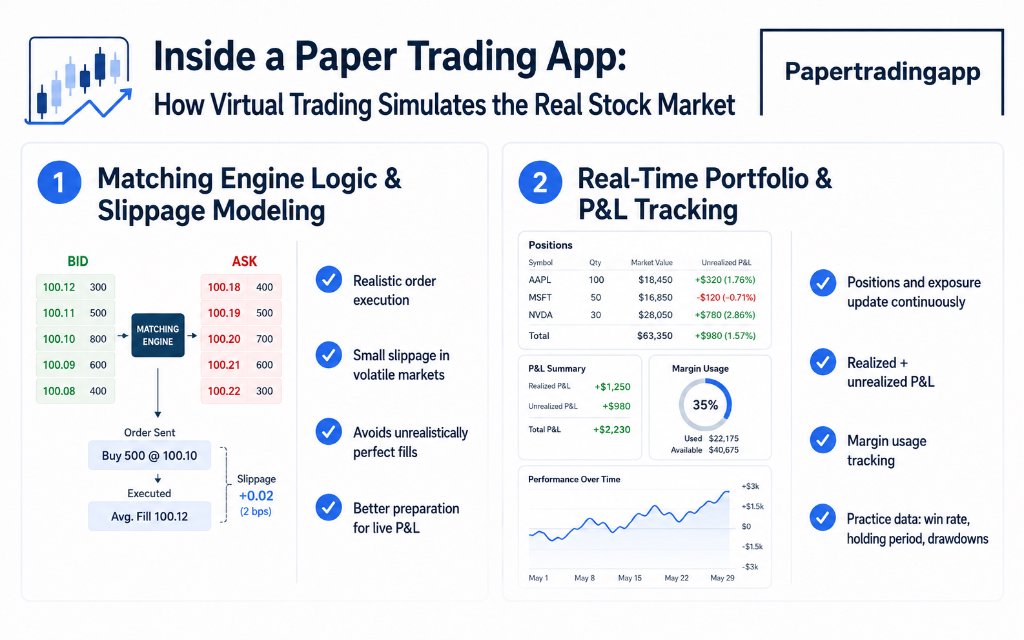
Most people think that a trading simulator is simply a game, with no numbers, no stakes and no real market. In fact, a paper trading application uses the same data infrastructure as a real brokerage, but instead of depositing real money it is just a paper trading account. The fact that you can understand what happens under the hood helps you better comprehend the reasons why practicing is a true preparation for real trading, and where it still can't.
What Actually Happens Behind the Screen When You Place a Virtual Trade
The platform is not generating a random number to display to you if you tap "buy" when using the best trading app. It's using real-time data from an exchange as it happens, the same price changes that flow into your professional trading terminal, as well as placing your order on that tradable data.
Live Price Feeds vs Delayed Data
Quality matters here. There are cheaper simulators that provide data that is outdated, or 15–20 minutes behind the market, which will deviate fast-moving trades such as scalping on the intraday time frame. A serious platform that is connected to real time NSE/BSE feeds will enable you to get the same price that you would obtain in a real account, at the tick level.
How Order Types Are Processed in a Simulated Environment
The good simulator not only allows you to place "buy" and "sell" orders, but also mimics the use of market orders, limit orders, stop-loss and bracket orders just as a broker's order management system would. The simulator will wait until the price hits the limit set below the current market price, as a real exchange order book would do. This is what makes it a learning aid and not a toy.
Why Simulators Feel Like Real Trading (Even Without Real Money)
Matching Engine Logic and Slippage Modeling
Advanced platforms simulate a realistic execution – even slippage during volatile times – to prevent you from having an unrealistic perfect fill each and every time. Why this is important is that if a beginner trains on too generous of a simulator, they are thrown a curveball with live trades as market slippages take a bite out of their P&L.
Portfolio and P&L Tracking in Real Time
For each virtual trade, there is a portfolio engine that monitors your trades, unrealized and realized profit or loss, margin usage and exposure — which is updated constantly as prices change. This is just like the stock brokerage account, but with virtual money. Over the course of weeks of practice, you can build up to a trading history, a true record of your wins, losses, average hold duration, etc. that you can study and enhance with.
Choosing the Best Trading App
Now, it's time to take a moment on the word, as it is here that the term is used. The classic, or traditional, notion of a best trading app would be those like Zerodha, Groww, Upstox, which are designed to allow users to place real-time trades quickly and effectively, charting, using broker-specific tools, etc. A paper trading app is created to grasp exactly how those very procedures function, without the repercussions of risking any cash.
What a Simulator Can Teach You Before You Commit Real Capital
- Strategy Performance: How good or bad your strategy will be under non-ideal conditions, as well as favourable conditions.
- Discipline: If you are able to stick to a stop loss discipline on a regular basis.
- Derivative Mechanics: How option/futures (F&O) positions change in relation to the underlying. The actual movement of F&O instruments (options, futures) against the underlying.
- Platform Fit: Which broker's charting, order flow, and interface actually match how you think — informing which live app you eventually pick.
Where Virtual Trading Still Falls Short of Reality
A simulator can't replicate something that is true about watching money leave your hands: the gut punch. But fear, greed and hesitation only appear when your own money is at stake—no matter how realistic the price data is. There are plenty of traders who are able to do the right thing once it is just a simulation, but when a real trade begins to move against them they abandon the strategy.
The fact that it isn't a bug in virtual trading is just a reminder of what it's supposed to do. Paper trading isn't meant to replace the feeling of actually trading in the actual market – paper trading is meant to remove the elements of worry and learning about the order types and margin calls for the first time for you.
That is where a platform like PaperTradingApp comes in handy. It provides ₹10 lakh of virtual money along with live data from the NSE & BSE, so when you practice the mechanics, like placing stop-losses, panicking in F&O and reading the price action in real-time, it's the same things you'll need to do in the future, not just a dumbed-down version. When you do invest real money, there's no new component except the emotional one.
Conclusion
The idea of a paper trading app was never conceptualized as a substitute for the market; a paper trading app is a true representation of the mechanics of the exchange, order execution, and portfolio math, without the risk of money. That's what PaperTradingApp aims to do: provide the exact S&P & NSE intraday data, the real types of orders, the real P&L tracker, and all on virtual money so that the novice trader can gain actual skill before he or she makes his first 'real' trades.
It won't get you used to sitting with real losses, nothing will except real trading. It will ensure that when you decide to actually choose a broker and start trading, you already know how the markets really operate, how your trading strategy is performing and whether you are prepared to put in the money.
Ready to see the mechanics for yourself? Practice with ₹10 lakh in virtual capital and live NSE/BSE prices — no Demat account, no risk, just real market data.
Frequently Asked Questions (FAQs)
1. Does using a paper trading app affect my real Demat or broker account in any way?
No — virtual and real accounts run on completely separate systems with no data crossover.
2. If I paper trade a stock I already own in real life, will it create any conflict or duplicate order?
No, simulated trades exist only within the app and never touch your live holdings.
3. Does my paper trading performance ever get reported to SEBI, brokers, or credit bureaus?
No, virtual trading activity is private and has no regulatory or credit reporting implications.
4. Can two people trade on the same virtual account to compare strategies against each other?
Most apps support only one login per account, so shared use isn't officially supported.
5. Does virtual capital in a paper trading app ever run out permanently if I lose it all?
No, most platforms let you reset or reload virtual funds once depleted.
6. Will a stock's real price movement in the market be affected by my virtual buy or sell order?
No, simulated orders are recorded internally and never touch actual exchange order books.

Editorial Team
Research & Editorial Group
The Alpha Trade Circle Editorial Team consists of market researchers, compliance analysts, and experienced traders committed to delivering unbiased platform breakdowns, regulatory verifications, and actionable market education.
Looking for more in-depth prop firm analysis and strategies?
Check out our partner, Prop Firm CircleReady to choose a broker?
Use our tools to find the perfect match for your trading style.
Get Weekly Forex Insights
Join traders who receive our weekly broker reviews, market analysis, and trading tool updates. Free, no spam.
No spam. Unsubscribe anytime. We respect your privacy.
Related Content
Why the InstaForex Cent Account is Perfect for Beginners
Learn why trading with a $1 minimum deposit on a Cent account is superior to demo trading for mastering forex psychology.
Why Cent Accounts are Better Than Demo Trading for Beginners
Learn why starting with a micro or Cent account is mathematically and psychologically superior to paper trading on a demo account.
The Ultimate Guide to Forex Broker Regulations (2026 Edition)
Your trading capital is only as safe as your broker regulator. We explain Tier-1, Tier-2, Tier-3 jurisdictions, segregated trust accounts, and verify licenses.
Best Forex Brokers for Beginners 2026 — Start Small, Learn Fast
New to trading? We rank the best forex brokers for beginners based on educational resources, low minimum deposits, and risk-free demo accounts.